The Selmer Mark VII
The major question about the Mark 7 has always been, "Why?" There are several theories, but I don't like any of them:
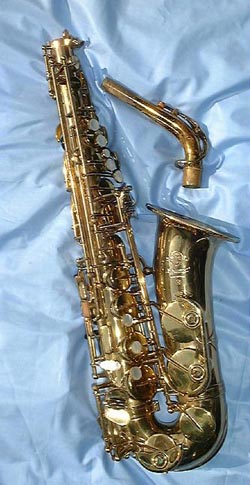
- Selmer just got bored with producing the Mark VI.
Doubtful in the extreme. While some car companies come out with a new model every six months, this has never been the case with any saxophone manufacturer. Change is generally motivated by $other_company that has a more popular horn than yours that's cheaper. Conn, for instance, left their alto, tenor and bari pro designs virtually unchanged for almost 25 years.
- The Mark VI tooling just plain wore out.
Doubtful for several reasons: first, remember that the 7 was only avaiable as an alto and tenor. Second, Selmer tweaked the VI design so often, it's virtually certian that they had multiple sets of tooling. Third, there's a long-standing rumor that Selmer sold the VI tooling to Yamaha or Yanagisawa. I doubt either would buy worn-out tooling.
- Selmer was losing money producing the VI.
Possibly, but the VI was instrumental in all but killing off the US and the French pro market for any other company, so I don't think Selmer was hurtin' for cash. Yes, the VI had a lot of hand-manufacture/assembly, but the VI was never as elaborate or expensive to produce as, say, a King Silver-Sonic with additional pearl inlay and it didn't have any odd keywork, like the Leblanc System horns, so it shouldn't have cost THAT much to produce.
- Selmer was actually losing market share to itself.
The Balanced Action and Super Action were becoming known as better sounding/playing horns with more character and the VI was selling poorly compared to these, much, much cheaper horns. Again, a possibility, but I've seen many posts saying that the vintage sax market really didn't exist until around the introduction of the 7 or Super 80. I also tend to doubt that the vintage market impacted anyone's sales significantly until the Internet came around.
Anyhow, it's most probable that the 7 design was cheaper to construct than the VI and Selmer's test market said that the 7 was "close enough" to a VI.
However, as the successor to the VI, the 7 failed miserably. Definitely not at first, but slowly ...
If you go into the music store and try one of these horns with the mindset, "This is just another pro horn," you'll be OK, but if you go into the store with the mindset, "This is the successor to the Mark VI. It's gonna be real kewl," you'll be sorely disappointed, not because the 7's a bad horn, but because it definitely has a different look, feel and sound than the VI: it's got those funky ergonomic keys, it's much heavier and it's darker.
In other words, it ain't a VI. It doesn't feel like one. It doesn't look like one. It doesn't play like one. It's not bad, though, it's just not a VI, which is what too many people want when they try these horns. Yes, it's a bit unfair, but blame Selmer's marketing.
There is one major "innovation" the 7 introduced: this is the first model line, excepting the marvelous Conn-O-Sax, to feature an altissimo F# key as standard equipment. Considering this was a somewhat expensive option on earlier Selmers, this might have been a good marketing tool.
Alto & Tenor Only
Officially, Selmer never produced anything other than Mark 7 altos and tenors, and only low Bb versions of either. However, occasionally, you'll see people saying, "I've got a low A Mark 7 alto!" No, you don't. The low A alto was a Mark VI design: no keywork differences, no bore differences. No "Mark 7" engraving. (See my note on Selmer serial numbers, below.)
UNOFFICIALLY, I have seen pictures of at least two baritones that are labeled "Mark VII" quite clearly -- and I've heard of one soprano and sopranino, too. However, these horns do not have the ergonomic low C/Eb keys and I doubt if these horns have anything in the way of a different neck or bore.
Now, Selmer's always had custom models. While I note that the Mark 7 baris I've seen had "normal" VI keywork, I wouldn't be overly suprised to see one with the 7-style ergo keys. I've also got pics of a VI alto that has a G# trill key and forked Eb (with attendant vent), like a Modele 26, so we have some precedent.
There always is some "fudging" of Selmer models around the time that a new model comes out and you may see, for instance, a bari labeled "Super 80", but with all the features of a VI. I think the reasoning is SUPPOSED to be that "what makes the model is the bore, not the keywork".
- A couple of very important things to note:
- There is always variation within Selmer models. Selmer tends to both experiment a bit (e.g., bow lengths on VI's) and adds new features as they patent them. This is the reason that, for instance, a late Super Action looks more like a VI than a Balanced Action.
- The official Selmer serial number chart is absolute trash, when it comes to models. NEVER look at that to determine what model Selmer you're looking at.
Now, I occasionally get e-mails from folks insisting that their (for instance) Mark 7 is really a VI, regardless of the fact that it's easily inside the serial number range for the 7. Their reasoning is, unvaryingly, that the horn has the same "look and feel" of the VI, so therefore it's a VI. I then ask for pictures. It's an obvious 7. The reader then gets mad when I tell them they have a 7.
I generally think that if there's a model name stamped on the horn, then that's what it is. However, in the case of this "Mark VII bari", I tend to think it's logically impossible that Selmer just happens to have an entirely different set of tooling for these horns lying around to have only a half-dozen or so "Mark 7" baritones -- it's just too expensive to do that. I CAN accept that the "Mark 7" bari does have a tweaked neck and/or different keywork, but I doubt if the bore is any different. I'd want someone to take a caliper to that thing to prove me wrong.
Of course, the "VII" engraving could just be a mistake, and Selmer meant "VI" :)