The Selmer Balanced Action
Introduced c. 1935 (appx. serial #21-22000 [ed. note: my earliest horn on file is s/n 20947]), the Balanced Action represented a significant change in the design and manufacturing of saxophones. Selmer streamlined the feel of the action by placing the bell keys all on the right side of the bell. The responsive action of the lower spatula was achieved by placing the rods down the front of the body instead of the side, a radical and innovative design. This was accomplished by a 14 degree turn of the bell-bow assembly and the neck. This allows for the newly designed bell-key and G# key spatula to direct the left little finger in a natural, closing motion rather than pushing "sideways". As a result, less exertion is needed to close the low B and Bb, and the key action is more direct and solid. (Previous models in the 1930's had the bell keys all on the left side, a design continued by the American manufacturers.)
Selmer explained it this way in their 1935 catalog:
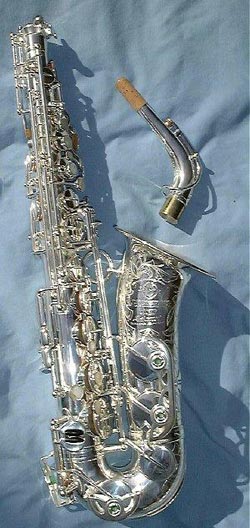
BALANCED ACTION EXPLAINED
Notice the simplified low-tone key leverages. Now the Bb, B, C# and G# work straight up and down, just as they do on a clarinet. The usual saxophone has more than 15 leverages -- "Balanced-Action" eliminates these differences. Now you can play just as fast in the extreme lower register as you can in any other part of the scale. Study the [pictures on saxpics' website]; note the extreme simplicity of the new mechanism. Fewer parts are used; action is more direct. Low tones speak more surely with "Balanced Action" because the shorter direct leverages make pads cover quickly and seal perfectly.
Selmer also claimed other innovations and improvements:
- New overhead leverage for G# key.
- Adjustable felt bumpers.
- Short key arms (giving faster, more positive closure on low Bb, B, and C#.)
- Low C# is double sprung and articulated.
For Selmer, the bell key repositioning offered other advantages besides the technical refinements. Again from Selmer:
Look at the back view of the new "Balanced-Action" Selmer. There are no moving parts next to your body. Nothing to catch in the clothing. No tone holes are muffled by the clothing. Long delicate low-tone key rods are completely protected from damage. Note the special shock-absorbing ring between the body of the sax and the bell. Permits freer vibration of bell and resists bell shocks without denting body of the instrument.
In their catalogue Selmer ballyhooed these changes by proclaiming:
There are three big reasons why you'll play 25% better with a "Balanced-Action" Selmer:
- You'll play faster. "Balanced-Action" eliminates the uneven leverage of the saxophone. You'll find the new Selmer has the same "feel" as a fine flute.
- The brilliantly tempered scale of the new "Balanced-Action" Selmer will help you to play better in tune. It is not necessary to '1ip' or favor any tones on the Selmer-they are built in tune.
- The "Balanced-Action" sax will make an immediate improvement in your tone. A special bore, combined with the resonance of French brass, gives the Selmer an unequalled timbre and carrying power.
The alto, tenor and baritone were attributed specific qualities due to the "Balanced-Action" design and improvements. The change in the bore created new wonders for the alto. According to Selmer:
The new Selmer alto is unequalled for tonal brilliancy, timbre, and carrying power. The improved bore will do wonders for your tone; you'll notice at once the added vigor and vitality.
[... and finally ...]
The "Balanced-Action" opens a new field for the baritone because it permits ultra-rapid execution, even on this larger instrument. A new bore gives this instrument a fuller, more vibrant tone, especially in the usually weak upper octave. Playing a few scales and octaves on this new sax will convince you that its intonation sets anew standard of excellence for the baritone. This instrument has the improved high F key and the fastest G#, low C#, B, and Bb you'll ever find on a baritone.
Selmer still made the sopranino, Bb soprano, C melody, [and Bb bass], but these were not offered in the "Balanced-Action" model at first. C-Melodies were soon dropped from production, and the sopranos were very rarely ordered, produced or purchased [again, Selmer denies that they ever made curved sopranos, visual evidence to the contrary]. In 1935, a gold plated elaborately engraved alto cost $382.00, far more than the $200 for the lacquered version. A lacquered tenor cost $215 ($442 for the gold-plated elaborate version). A lacquered "Balanced-Action" baritone cost $245.00.1
Something major to note: these were the first Selmers to offer an altissimo F# as an option. Most people comment that the addition of this additional key and tonehole plays havoc with the horn's intonation. Considering the altissimo F# is rather rare and I've not played a BA with one, I'm going to accept this assertion.
"One more word about the BALANCED ACTION SELMER models, and that is, at their inception, Henre LeFevre Selmer, head designer at that time, was really in an experimental mood, since I have seen no fewer than seven different mechanism approaches and configurations used, including even an interlocking gear movement in the octave mechanism and various types of springing for the right hand stack keys. At least, that which he settled down to was superbly done."1
Finally, the major question I'm asked is, "How can you tell if it's a BA or an SBA (Super Action)? It's not labelled on the horn!"
- The two things to look at are:
- The connection between the body and bow. If it's soldered, it's a Balanced Action. If it's got two little screws -- which was Selmer's patent for a "Remova-Bell seal" (FR920653) -- it's a Super Action. (Actually, there's a key post soldered to this connection ring on the BA, thus suggesting that the proportions are different.)
- The toneholes. The toneholes on the BA are arranged in a more-or-less straight line. The SBA has toneholes on the upper stack offeset a bit to the lower stack, giving the keywork a more "radial" look.
Using these above two techniques, the earliest SBA I've got pictures of is in the 334xx range. Evidence does suggest that altos were switched over to the "SBA-style" first.
There are also a number of minor tweaks that you can see on the alto and/or tenor, but they're not entirely consistent, but I'll mention them here anyhow:
- The bell on the SBA is longer. Relatively shaky ground on this ...
- The LH pinky cluster is more "Mark VI-like" on the SBA -- at least the connecting rods are. Again, pretty shaky.
- The serial number for the SBA is NEVER on the bell. Seems solid, but it seems the s/n was moved to the body around s/n 28xxx or so.
- BA's generally have seperate keyguards for the low B and Bb. This is a very shaky means of determining the BA and SBA because the style of keyguards on the BA and SBA is kinda random.
Jimmy Dorsey Model
The Jimmy Dorsey model was also released early into the Balanced Action run. This is Selmer's rarest model, with possibly only 200 horns produced. SAXTEK also has a few comments:
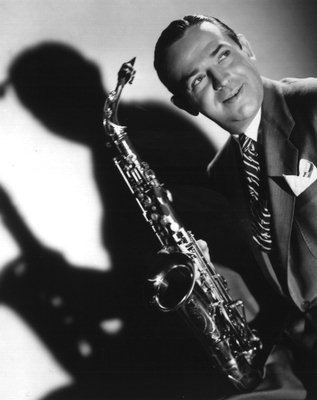
Jimmy Dorsey with a Jimmy Dorsey Model alto. Note the keyguards.
"I've seen two Jimmy Dorsey model Selmer altos. They have sheet metal keyguards, like the Balanced Action, but the bell keys are on the left side, like the Cigar Cutter. The bell keyguard is a bit odd, because it has a keyguard just like the Mark VI grafted to the wire 'wishbone' of the earlier Supers (Cigar Cutters). My own personal opinion is that Selmer had some Super bells left after starting Balanced Action production, so they used them. The Jimmy Dorsey horns, however, play great and Jimmy did use one."2
Finally, I've recently found that there were some Super and Radio Improved horns available considerably later than the Selmer serial number charts would indicate. Beware of these horns: they are not Jimmy Dorsey models (unless they have the sheet metal keyguards). They may have Balanced Action engraving, though.
I believe these horns are special-order models from people who liked the Super keywork and thought the left-hand bell key arrangement was faster. If it's true that the Jimmy Dorsey model was essentially a Super body with Balanced Action keywork, it's probable that Selmer sold other previous models as a specialty item.