The Selmer Super (Balanced) Action
The Super-Action were designed contemporary commercial applications. The ads claimed a "A Brighter Sound," "Unequaled Carrying Quality," and "increased agility and more accurate intonation." This was achieved in part through a slight modification of the neck proportions, a trend that continues with contemporary saxophones. According to the 1947 Selmer catalogue:
(The) "New neck bore proportions improve tone and give additional carrying power and vitality. Long, heavy reinforcing rib on neck gives extra strength."
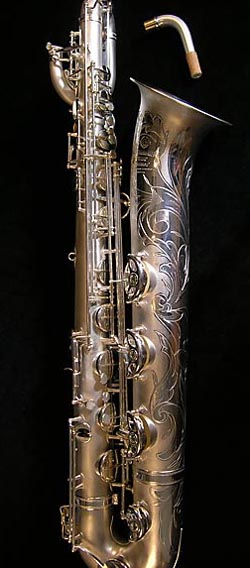
The most striking and truly innovative design change concerned the keys and tone-holes between the upper and lower stack. The upper and lower hand keys were offset from each other. This ergonomic approach considered the natural position of the hands and fingers in designing and adapting the saxophone mechanism. Up to this time, tone holes of the main scale were positioned in a straight line. This linear symmetry of the key position relative to the straight line tone holes was an accepted and standard design. The Super-Action modification was a radical departure from this norm. The top and bottom hand tone-holes are not in a line but are now at an angle to each other. This change accommodates the natural position of both hands, and theoretically enables a more comfortable and fluid technique.
According to Selmer, from the 1948 catalogue:
The main right-hand and left-hand key groups are offset to place the fingers, hands and wrists in easier playing position. This is a basic saxophone improvement and makes possible better, faster, easier key action - truly effortless playing.
This was a fundamental change from all previous saxophone mechanisms, and no doubt felt unfamiliar to players of the time. But the more natural positioning combined with the advanced design of the shorter key arms, direct leverages of the lower tones, ribbed key construction and new octave mechanisms set a new unrivalled standard. To be sure, other manufacturers were implementing their own enhancements and improvements, but none were as revolutionary as the Selmer Balanced-Action and Super-Action.
Invisible to the player but no less significant to the instrument is an innovative manufacturing change. The bow and bell are now hermetically sealed instead of soldered. The solder-less socket fit and screw-assembled band and bell-body attaching ring made for much easier dent removal und servicing. Selmer called this feature "Remova-Bell" and it was a boon to technicians. In their 1948 catalogue, Selmer described it as:
"Hermetically sealed bell and bow are completely detachable. Speeds up servicing (so infrequent with a Selmer)."
Another unprecedented innovation was the introduction of the first commercially produced low A baritone. We usually think of the low A baritone as a Mark VI innovation. But in 1952, Selmer introduced their first low A baritone in the Super-Action model. At first, the low A was listed as an option to the model no. 55 baritone. Later that year it was given its own model designation, no. 55A.
The Super-Action and Mark VI low A baritones are similar in many ways, making it difficult and confusing to appreciate their differences. Two instruments are identical in weight, although the Mark VI stands just little higher. The palm keys are slightly higher on the Mark VI, although the Super-Action has a lighter action (as do all the Super-Actions) and the engraving is more ornate. The low A mechanisms are very similar, but the shape of the Mark VI design makes it slightly easier to manipulate. Their subjective evaluation proved especially interesting [and my testers] felt that the Mark VI was more resistant in blowing.
The darker tone quality of the VI was offset by the lighter and more responsive quality of the Super-Action. The intonation was good on both. [Both my testers] felt that the Mark VI was more consistent in tone throughout, but they also seemed to prefer the Super-Action basic sound quality for much of their solo and ensemble work. I was surprised at the responsiveness and the lithe quality of the Super-Action. For me, it had a more singing, soloistic quality than my Mark VI, and felt almost as comfortable. Both are superb horns, both with different qualities. It is difficult to decide between them, becoming a question of style more than quality.1
Something major to note: this was the second Selmer model to offer an altissimo F# as an option. Most people comment that the addition of this additional key and tonehole plays havoc with the horn's intonation. Considering the altissimo F# is rather uncommon and I've not played a SBA with one, I'm going to accept this assertion.
Allgedly, there were at least three different versions of the SBA (changes found primarily on the alto and tenor):
- The first version seems to have a bell very similar to or identical to the Balanced Action. I can support this opinion, logically, by saying that the first few horns produced after WWII would have necessarily been made with spare parts, but I haven%u2019t had a chance to actually compare and contrast late BA%u2019s with early SBA%u2019s.
- The second version seems to be the horn that Selmer advertised as having a longer bell and the redesigned neck, as mentioned in the article from Dr. Cohen, above. The other differences include the separate keyguards over the low B and Bb.
- The third version is again a slight redesign of the bell, possibly tweaking the bore slightly, but definitely changing to a one-piece keyguard on the low B and Bb.
In my opinion, there were changes added throughout the entire SBA series of horns and these changes, put together, were slightly improved upon - and a couple new patented design features were added - and you got the Mark VI. In other words, the newer the SBA, the more features you had and the more VI-like the horn was.
I encourage you to take a look at the many pictures I have available for these horns over the few years they were produced and compare and contrast them with the BA and the VI.2
By the bye, folks occasionally ask why these horns are called Super Action horns in some places and Super Balanced Action horns in other places. The OFFICIAL Selmer model name of these horn is, indeed, "Super Action".
Around 1981, Selmer released the Super Action 80. The naming was intentional: Selmer wanted former customers -- and a lot of them were former customers -- to recall the Super Action horns, rather than the Mark 7.
Essentially, to avoid confusion, it became accepted practice to call these older horns "Super Balanced Action" horns, or SBA's, for short, to avoid confusing them with the Super Action 80's.
This section bears repeating from my Balanced Action page:
Finally, the major question I'm asked is, "How can you tell if it's a BA or an SBA (Super Action)? It's not labelled on the horn!"
- The two things to look at are:
- The connection between the body and bow. If it's soldered, it's a Balanced Action. If it's got two little screws -- which was Selmer's patented "Remova-Bell seal" (FR920653) -- it's a Super Action. (Actually, there's a key post soldered to this connection ring on the BA, thus suggesting that the proportions are different.)
- The toneholes. The toneholes on the BA are arranged in a more-or-less straight line. The SBA has toneholes on the upper stack offeset a bit to the lower stack, giving the keywork a more "radial" look.
Using these above two techniques, the earliest SBA I've got pictures of is in the 334xx range. Evidence does suggest that altos were switched over to the "SBA-style" first.
There are also a number of minor tweaks that you can see on the alto and/or tenor, but they're not entirely consistent, but I'll mention them here anyhow:
- The bell on the SBA is longer. Relatively shaky ground on this ...
- The LH pinky cluster is more "Mark VI-like" on the SBA -- at least the connecting rods are. Again, pretty shaky.
- The serial number for the SBA is NEVER on the bell. Seems solid, but it seems the s/n was moved to the body around s/n 28xxx or so.
- BA's generally have seperate keyguards for the low B and Bb. This is a very shaky means of determining the BA and SBA because the style of keyguards on the BA and SBA is kinda random.